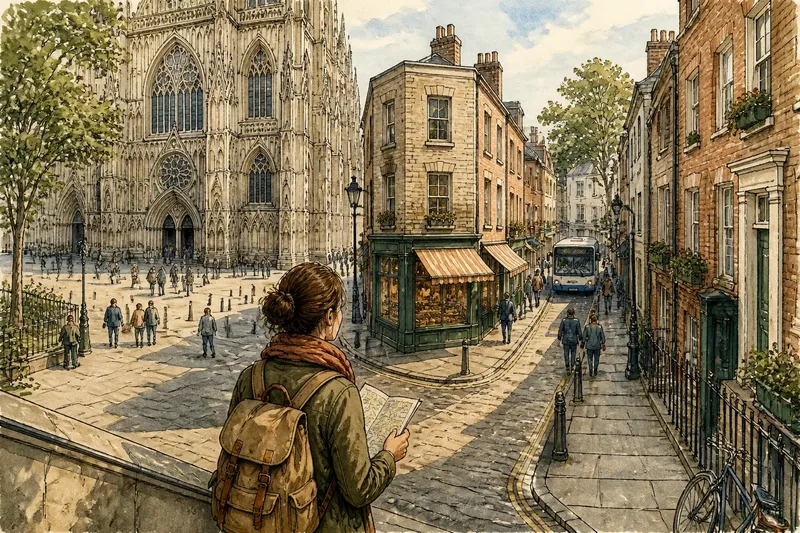
Train, Bus or Walking: Choosing the Shape of a City Day
Choosing how to get around a compact city shapes what you notice, how much effort you spend and where the day’s transitions happen.
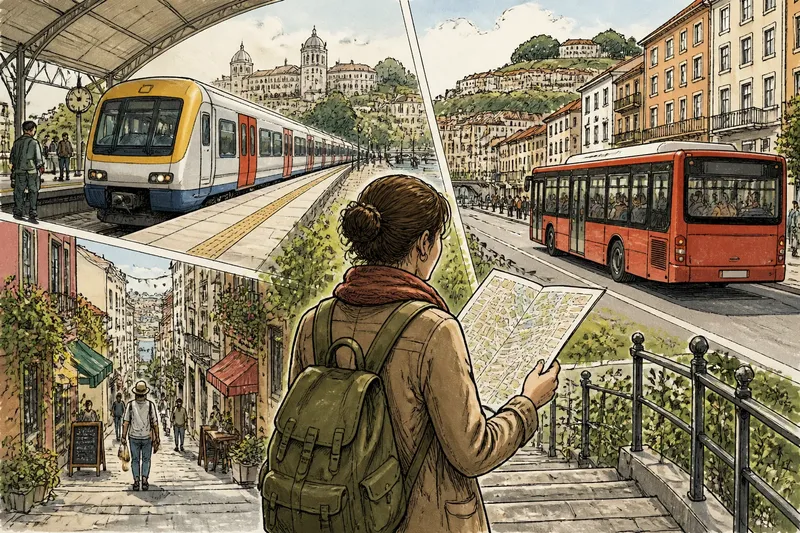
Choosing between train, bus or walking in a compact city changes more than how quickly you reach the next stop: it shapes what you see between places. A train links distinct areas with a clear break; a bus keeps the streets in view while carrying you through them; walking lets you set the pace and change direction whenever a detail catches your eye.
What should shape your choice of transport?
Start with the character of the outing, not a rule that one mode is always best. Ask what you want the journey itself to contribute. Are you connecting distant districts, watching the city unfold, or exploring a small area closely? Then consider the day’s physical demands, the weather and how much attention you want to give to routes and crossings.
Compact cities can still feel tiring if the day involves hills, crowded pavements, frequent stops or a heavy bag. A mixed approach often makes sense: walk through one neighbourhood, take public transport to another, and decide afresh there. The point is not to minimise every journey, but to choose transitions that suit the places between your plans.
Check route maps, service information and local pedestrian access before setting out. Fares, ticket rules, accessibility and services depend on local operators and conditions, so follow the relevant instructions.
When does a train make the day easier?
A train is useful when you want a dependable link between areas that feel separate on foot, such as a central district and a residential quarter beyond it. Stations also give a clear sense of transition: the busy platform ends, the doors open elsewhere, and you emerge ready to pay attention to a different set of streets.
That separation is a strength if you have limited energy or want to save your attention for the destination. It can also be a drawback. Underground sections hide the surface route, and station entrances may place you away from the street or landmark you expected. Look at the station’s exits on a map, then orient yourself at street level rather than assuming the first exit is the right one.
Choose the train when the link between districts matters more than seeing every block along the way. It suits travellers who prefer a clear boundary between one part of the day and the next.
What can a bus show that a train cannot?
A bus offers a moving view of ordinary street life: shopfronts, housing, junctions and changes in building style. That makes it a useful bridge when you want to understand how two areas connect without walking the full distance. Unlike a train, it keeps the surface city in view, though traffic and crowded stops can make the ride less predictable.
Bus routes can be harder to read if several services share a stop or travel along similar roads. Check the destination shown on the vehicle and the direction of travel, not only the route number. If you are unsure where to get off, follow the route on a map and watch for a recognisable junction or public building.
Say you are leaving a riverside quarter for a hilltop neighbourhood and want to see the streets rise between them. Taking a bus uphill could preserve your energy while keeping the changing view visible; getting off near the upper streets would leave you free to explore on foot. The result to look for is not a particular sight, but a clearer sense of how the two areas meet.
Pick the bus when the route itself is part of what you want to notice, and you are comfortable checking stops as the city moves past.
Why can walking make a short route feel richer?
Walking gives you the most control over pace and direction. You can pause at a doorway, follow a lane that looks interesting or turn back when a street becomes noisy. Those small choices reveal details that a vehicle window can flatten: a change in paving, a courtyard entrance or the way a row of shops gives way to homes.
The trade-off is effort and exposure. A route that looks short on a map may involve steep streets, awkward crossings or little shade. Pavements can also be narrow or uneven. Walking suits travellers who enjoy close observation and can adapt their route, but it may be less appealing when carrying luggage, managing fatigue or crossing a large stretch with few places to pause.
Use walking for a district you want to read at street level, rather than treating it as the default for every connection.
Which way of getting around fits your day?
Which option is best for seeing street life?
Walking gives you direct contact with the street, while a bus offers a continuous view over a longer corridor. A train is less suited to noticing surface details between stations, but can carry you efficiently to a place where a walk begins.
Which option asks for the least physical effort?
Train and bus journeys reduce the distance you cover on foot, though stations may involve stairs and stops may be crowded. Check access information and consider the walk at each end, not just the ride itself.
How should you choose when the weather changes?
For rain or strong sun, use public transport for exposed or tiring stretches and reserve walking for shorter routes with places to pause. A bus may keep the city visible without requiring you to stay outdoors, while a train can make a longer connection feel simpler.
Can you combine all three on one outing?
Yes. Give each mode a different job: walk within one area, use a bus for a surface-level connection, and take a train when you want a clear jump between districts.
How can you choose without overplanning?
Mark the main places you want to visit, then look at the route between them rather than plotting every turn in advance. If the path crosses a steep or uninteresting stretch, consider transit. If two stops sit close together in a district you want to explore, walk between them. Leave room to change your mind after seeing the streets.
- Check the terrain: note hills, rivers and other barriers that change the effort of a walk.
- Look at station entrances: confirm where a train journey will put you on the surface.
- Follow the bus direction: check the displayed destination and route map before boarding.
- Allow for street crossings: a direct line on a map may not be a direct pedestrian route.
- Notice your energy: choose a seated journey when the next area calls for more walking.
- Keep one flexible connection: leave a route open to a bus, train or walk if your pace changes.
Choosing train, bus or walking is ultimately a way to shape what the city gives you between destinations. For a day built around distinct districts, the train can create a clean transition; for observing streets in motion, the bus keeps the surface view; for noticing small details, walking leaves the most room to respond. Before setting off, decide which stretch deserves your attention and which one is simply a connection.