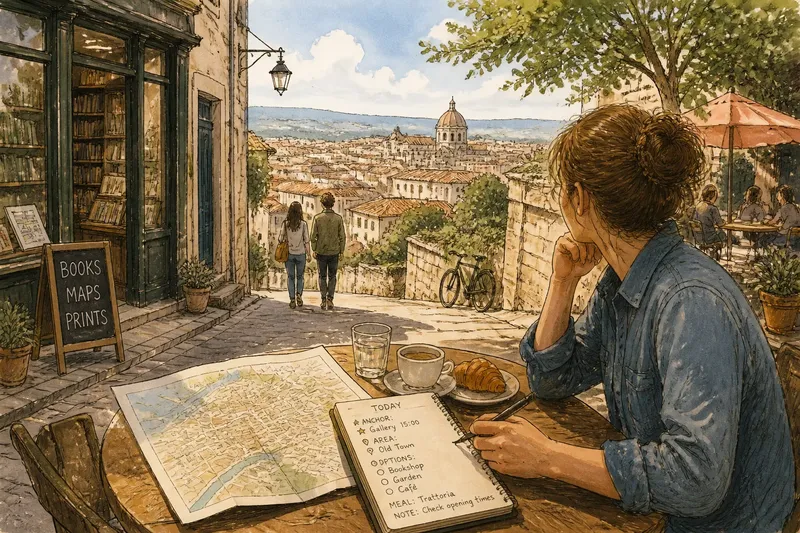
The Travel Sketchbook Before the Camera Roll
A travel sketchbook turns fleeting details into useful memories. Learn how to keep one practical, personal and easy to return to after a trip.
Why keep a travel sketchbook when a phone can photograph a street in an instant? Because a sketchbook records what caught your attention, not just what stood in front of you. A doorway’s chipped blue paint, the route from a station to a bakery, or a phrase heard at a ferry stop can become a practical memory aid now and a personal keepsake later.
That double role can make the habit awkward. You may feel you need to draw well, write at length or fill every page. In practice, most difficulties come from treating the book as a finished artwork rather than a place to leave useful traces. If you know what is getting in the way, you can adjust the way you use it.
Why does a travel sketchbook feel like homework?
A blank page can seem to demand a complete scene. That expectation turns a quick pause into a task: find the right angle, make the drawing look convincing, then add a polished caption. The pressure is especially distracting when you are travelling with someone or trying to make a connection.
Give each page a small purpose instead. Write down a place name and one detail; draw the outline of a window; or note the colour of the tiles beside a short route. These fragments are not failed illustrations. They are prompts that help you recall what a photograph may leave ambiguous: what felt distinctive, what you noticed first and why you stopped.
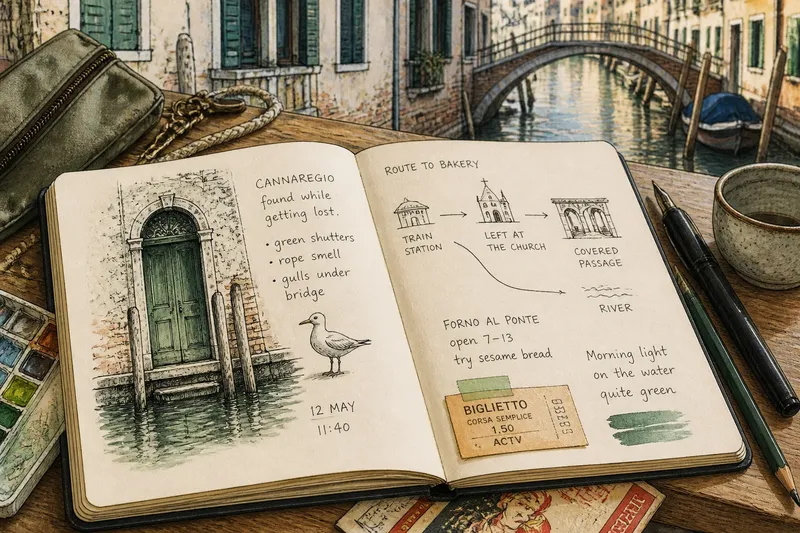
Say you have a few minutes beside a canal in a town you have just reached. You jot “green shutters, rope smell, gulls under bridge” and make a small line drawing of a waterside doorway. Later, those details may help you recognise the place in a camera roll or remember why that lane stayed with you.
Start with one observation, not a complete picture.
Why do the notes make sense on the day but not later?
Travel notes often rely on context that seems obvious at the time. “Good coffee near the square” may be clear while you are holding the cup, but vague once several towns and cafés have blurred together. A sketch can be equally hard to place if it has no name or clue attached.
Add a small anchor to each entry. This might be the street, neighbourhood, transit stop, or a nearby landmark. If you do not know the spelling, write it as you heard it and mark it for later checking. A date can help too, but the useful detail is the one that identifies the setting.
Separate observation from interpretation when it matters. “Three stools facing the counter” records something visible; “locals come here after work” is an inference unless you have a reason to think so. Keeping the distinction clear makes the book more reliable as a memory aid and leaves room for your understanding to change.
For a route, use arrows and a few landmarks rather than a map-like drawing. A note such as “station exit, left at the church, covered passage to the river” may be easier to use than an elaborate street plan.
What if drawing feels too slow or difficult?
A travel sketchbook does not require drawing skill. Simple marks can describe shape, arrangement and texture without trying to reproduce a scene. A row of rectangles can suggest balconies; a rough circle and a few strokes can record a bowl of fruit. Labels do much of the work that detail would otherwise have to do.
Choose tools that suit the conditions. A slim notebook and a pencil are easy to use while standing; a water-resistant pen can help when you want to avoid smudging, but it leaves less room to revise. Coloured pencils are useful for a small accent, while carrying a full paint set may be more cumbersome than the moment deserves. Keep the kit modest enough that taking it out feels simple.
Try a mixed entry: a rough drawing, a few words, and a mark showing direction or scale. You can also press a ticket or paper wrapper between pages, then add a note saying where it came from. Avoid collecting materials that are fragile, protected or not yours to take; a quick description can preserve the memory without removing anything.
Use words as part of the drawing, not as an apology for it.
How can you keep the sketchbook useful without interrupting the day?
Some travellers write too little because they wait for a long, quiet pause. Others record every stop and miss the experience they hoped to remember. The solution is to make entries small enough to fit naturally around the day: while waiting for a meal, sitting on a train, or resting after a walk.
Decide what the book is for before you open it. For practical recall, record names, directions, opening details you need to check, or a description of a useful service. For place-reading, note sounds, smells, patterns of use and contrasts between streets. For a keepsake, collect moments that carry a personal association. One entry can serve more than one purpose, but you do not need to make every page do all three.
If privacy or etiquette is a concern, record the setting rather than a recognisable person. A sequence of sounds, the arrangement of chairs or the way a queue forms can describe a social scene without turning someone into a subject. Where a label, maker’s guidance or local rule governs what you may record or collect, follow it.
Keep a few blank pages for loose notes, small sketches or a name you want to verify later. On returning home, add only the context that would otherwise disappear. The book need not become a polished journal; a brief correction or place name can make a page legible without erasing the immediacy of the original mark.
Which sketchbook problem are you trying to solve?
What should I put in a travel sketchbook?
Record a place name, one specific observation and any detail you will want to recall, such as a route, texture or sound. A small drawing is optional; a labelled mark can be enough.
How do I keep a travel sketchbook when I cannot draw?
Use simple shapes, arrows and descriptive words together. The aim is to make the scene recognisable to your future self, not to produce a technically accurate picture.
Should I sketch or take a photograph?
Use a photograph when you want to retain visible detail quickly, and a sketchbook when choosing and annotating a detail matters. The two can complement each other: a written note can explain why one image matters among many.
How can I make old travel notes easier to understand?
Add place names and short context while the setting is still clear, then revisit uncertain spellings later. Keep direct observations distinct from guesses so the memory remains honest.
When does a record become a keepsake?
A practical note becomes personal through the associations attached to it. A café name may recall a rainy afternoon; a crooked sketch of a doorway may bring back the conversation that happened nearby. These details do not need to be grand or attractive to matter. Often, their value lies in being specific to your attention at that time.
Leave room for the book to change roles. During the trip, it can help you remember a turn, a local word or the colour of a façade. At home, the same marks can become a record of what you noticed and what you did not yet understand. If you return to a place, new notes beside the old ones can show how your attention has shifted.
The best travel sketchbook is not the one with the fullest pages. It is the one whose small, well-anchored details still bring a place into focus. Keep a few words beside each sketch, and the book can serve both the next turn in the street and the memory that lasts after you leave.